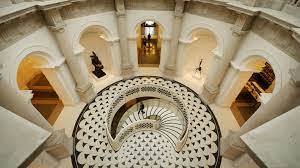
After the excitement of Boris Johnson leaving 10 Downing Street for the final time as PM and the flights to Scotland for him and new PM Liz Truss, I had to find something that would equal or top that excitement on the cultural front. I thought that the Tate Britain might be just the thing, so I walked up to King Cross Tube Station and headed down to the Pimlico stop on the Victoria line. While the day was quite pleasantly cool, the Tube was unpleasantly warm, and I was glad to arrive at Pimlico station and get back out into the sunshine and cool air. The streets between Pimlico Station and the gallery are always pleasant to pass through. There are lovely white fronted townhouses and then the scenery changes as you near the Tate with the appearance of the red brick Millbank Estate, built at the end of the 19th century. It is now a grade II listed building in the arts and crafts style of architecture and very pleasant to look at. Just across perpendicular roads from the Millbank Estate and the Tate is the Chelsea College of Art in buildings that used to house the Royal Army Medical College. Below are photos of the Millbank Estate on the left and one of the buildings of the Chelsea College of Art on the Right.

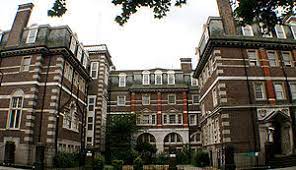
It has been almost twenty years since the old Medical College closed but I still think of it when I pass by. It is another example of London constantly reinventing itself. In fact, I believe the Tate Britain is housed in a building that was once a prison.
Once I made my way into the Tate, I first checked to see if there were any special exhibitions of interest and was able to determine that I could spend my time visiting the permanent collections that seemed to have been “re-curated” since my last visit. However, I thought I would start by having a cold drink in the Member’s Room. As you do when you reach a certain age and it’s a damp kind of day, I headed for the elevator that would allow me to avoid the long spiral staircase to the member’s room. As has been the case on almost every visit to this Tate venue since they moved the Member’s Room to this location high in the building’s dome, the elevator was not working. I did the survival challenge, then and took the steps. After a refreshing drink, I took the somewhat vertiginous steps back down and began my tour of the rooms that looked to be of the most interest to me.
Low and behold, I struck gold very quickly when I stepped into a room dedicated to St. Ives school of modern and abstract British art that flourished from the 1940s to the 1960s. This included one of my favorite artists, Patrick Heron, three of whose works appeared in this one room. Heron’s use of color has captivated me in a way that I find hard to describe. I can get lost in his work and spend long periods of time simply admiring a piece of it in the silence of the gallery. I thought that this would be such an occasion. Then suddenly, a sound of loud offkey children’s singing infiltrated the room I was in from an adjoining one. Its source was an audio-visual display in the corner of the adjacent room. The singing destroyed the serenity of the moment for everyone in the general area and went on far too long. Finally, it ceased, and I was able to have a few more moments of peace with works of the great English artist. Below are the three Heron works, with me ecstatically enjoying thrm.
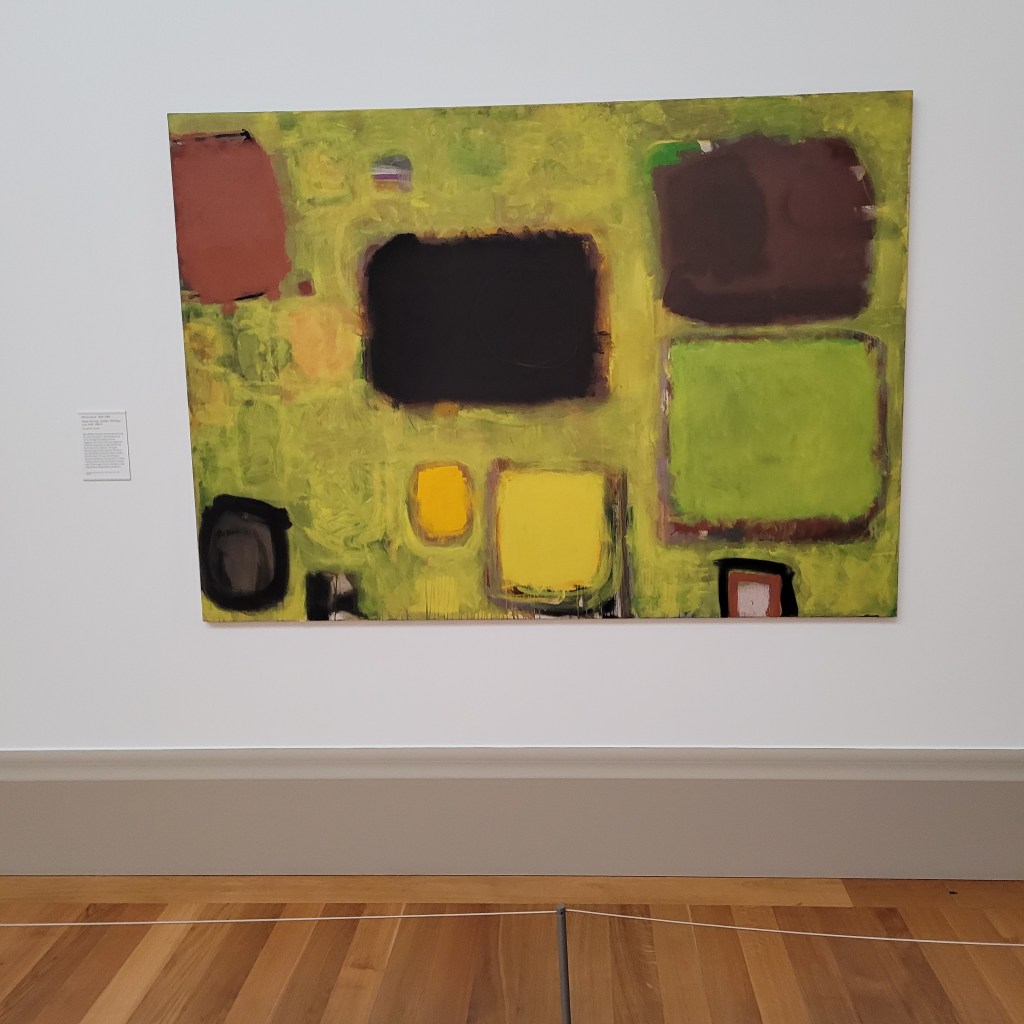
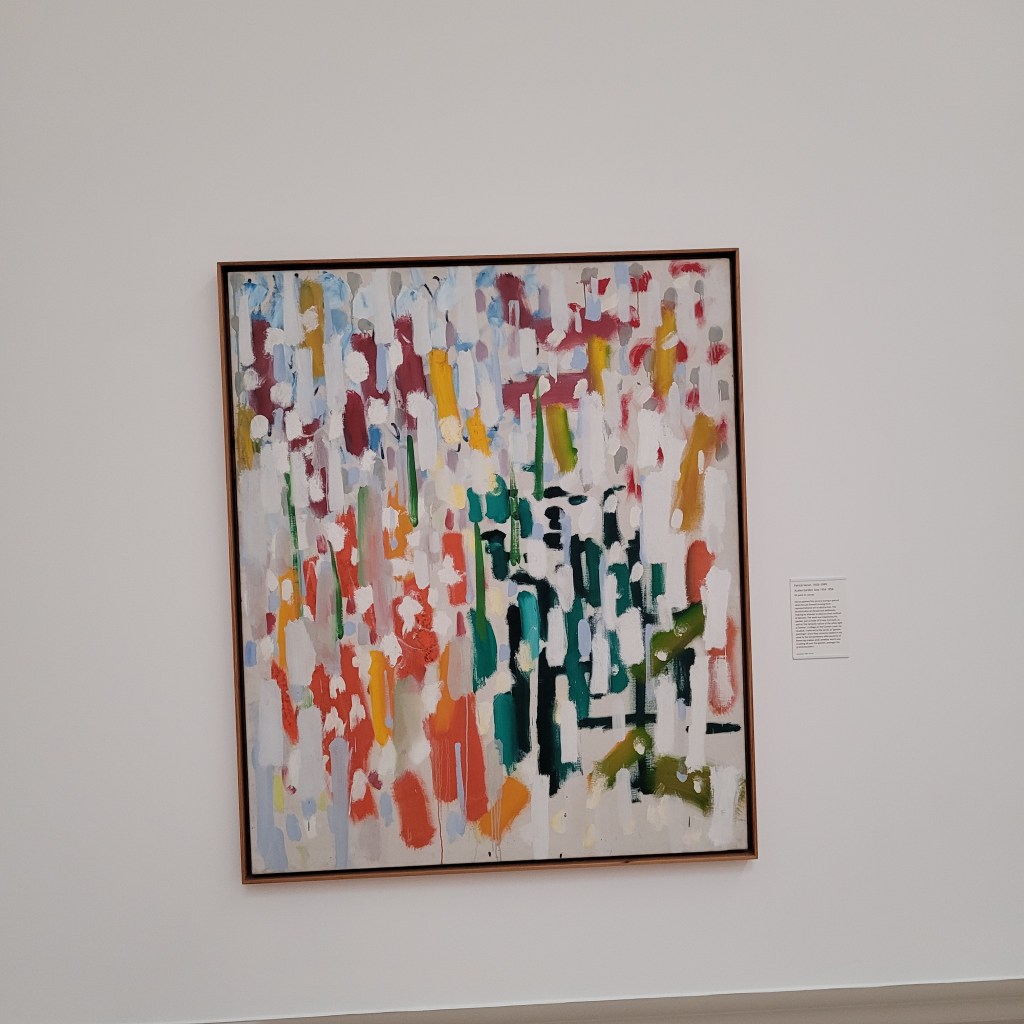

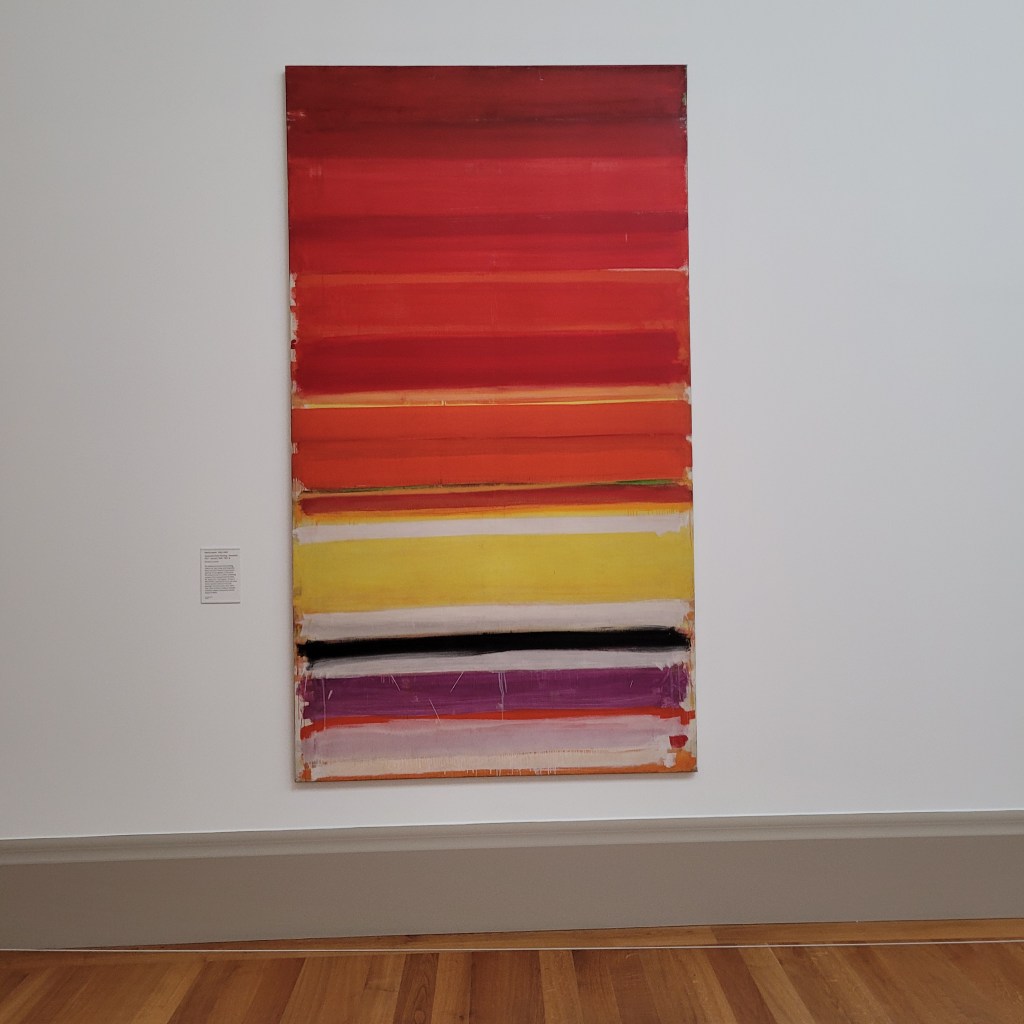
There was much more to see, of course. Here are two more colorful pieces that I really enjoyed seeing during my visit. The first piece below is by Jeremy Moon who used the grid to explore the relationship between flat surfaces and three-dimensional ones. The second one is By Howard Hodgkins and is also one where lines and dimensions are important, but a figure appears, as well. I am also drawn to the colors.


There was so much more to enjoy. Before I move on to sculpture, I’ll mention, in passing, Mark Rothko’s Seagram Murals. Originally painted for the Four Seasons Restaurant in the Seagram Building in New York City, the artist gave them to the Tate. Because of their fragility, they are kept in a special low-light gallery, and I am never terribly satisfied with photos of them. Do go to see them if you have the chance. Of course, one can’t speak of the Tate Britain without saying “the T word,” (Turner). The gallery’s J.M.W. Turner collection is world renowned. Turner’s paintings are beautiful and should be seen and admired. The way he brought sunshine and light into his seascape is breathtaking.
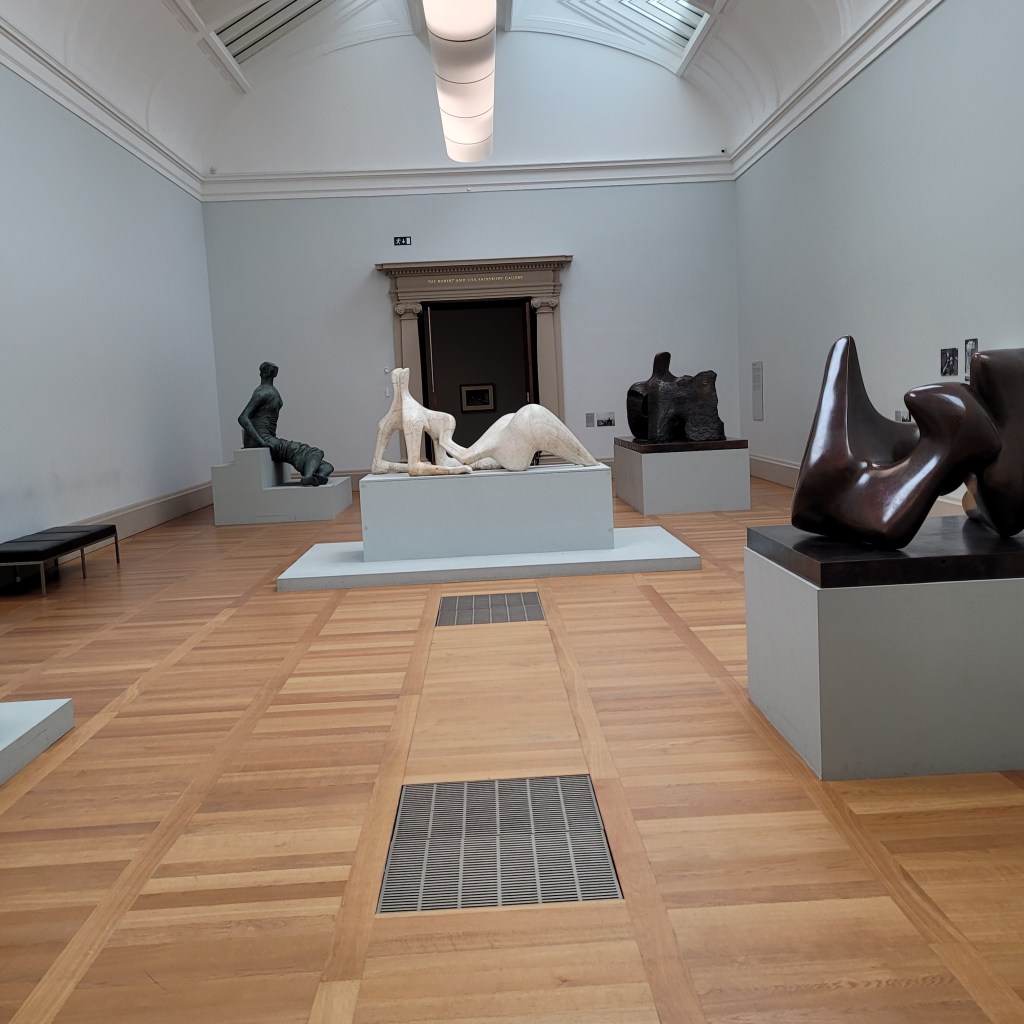
Another major collection in the Tate is the sculpture of Henry Moore. His large pieces have always delighted me and are another example of art that opens my mind to thought and fancy. As I continued my walk through the 20th century galleries, I walked into a room filled with Moore sculptures! See below. It was almost comical, at first, but they were well spaced, and the room was not crowded with people, so it worked well enough.
Finally, at the other end of the sculptural size spectrum, I found these two small sculptures by Alberto Giacometti. The Tate described him this way in material for a 2017 exhibit that I remember fondly, “Giacometti was an artist both rooted in the exact and transported by the visionary. He was both a maker and a seer, both a craftsman and an alchemist. He was interested in the deepest and most precise contours of the face, but had no interest in making mere representations of those who sat for him. His drawings, which are exquisite, do not read like preparations for his sculpture or his paintings; it was as though everything he touched he sought to perfect, knowing all the time that he would fall short.”

These two works, ‘Walking Woman and Woman of Venice are good examples of his work, direct and eloquent.
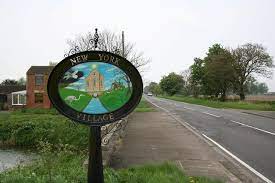
After an immersion like that in the world of art, I treated myself to a Black Cab ride home and “struck gold” again with a chatty cab driver. This fellow prided himself on knowing American State capitals and had visited many American States. He was also heading off to a wedding in Minnesota, where he had family, this weekend. I told him about the casino in Welch, MN, about an hour outside of the twin cities of Minneapolis and Saint Paul. The casino is owned and operated by the Prairie Island Dakota Indian Community. He was a wealth of information on local history, telling me about the poverty in the Elephant and Castle area in days gone by, how the rich would go to the old St. Mary’s Bethlehem (corrupted and shortened to Bedlam) psychiatric hospital and taunt and abuse the inmates there. He also talked of historic sites associated with early English people who left for America in various places. He was quite interested with the British city of Boston and that he believed that there was a village near it called “New York.” And there is in Lincolnshire. Below, a sign from the Elephant and Castle Tube Station, a black engraving of the Bedlam Hospital, the church in Boston Lincolnshire, as large as many cathedrals, the cab driver told me. And, finally, a sign for New York, Lincolnshire.


We also had a rather fun discussion of how school discipline had changed since our school days. It seemed that UK teachers, like their American counterparts, had pretty good arms and could hit a misbehaving student with an eraser, chalk or other handy non-lethal weapon quite well on either side of the Atlantic in the old days. Our PE teachers in American and their “games” teachers had some extra leeway too. My how times have changed!
 Mark In London